


The emir of Daura had taken off his slippers. The white shoes perched on the rug beside him while he rested his bare foot on a pouf. He dressed in white, his turban wound high and knotted on top. Behind him hung a tapestry of bright green and red squares stitched in gold. In the middle of the cloth, a snake coiled around a sword. We sat around him in silver baroque armchairs, barefoot or in our socks. Our Nigerian companions and others sat on the floor in front of the emir. A fan stood next to them, blowing toward the throne.
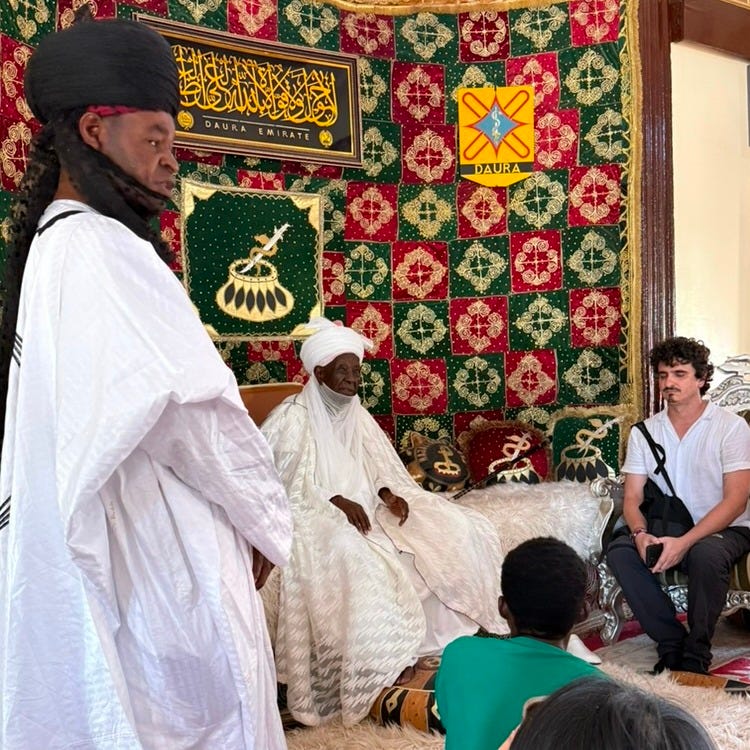
He asked who we were and our reasons for coming. We explained we were travelers from many countries around the world. He welcomed us. That was pretty much it, except for the photo op. We were honored guests, but not so different from the regular stream of locals, government and business folks who come before him.
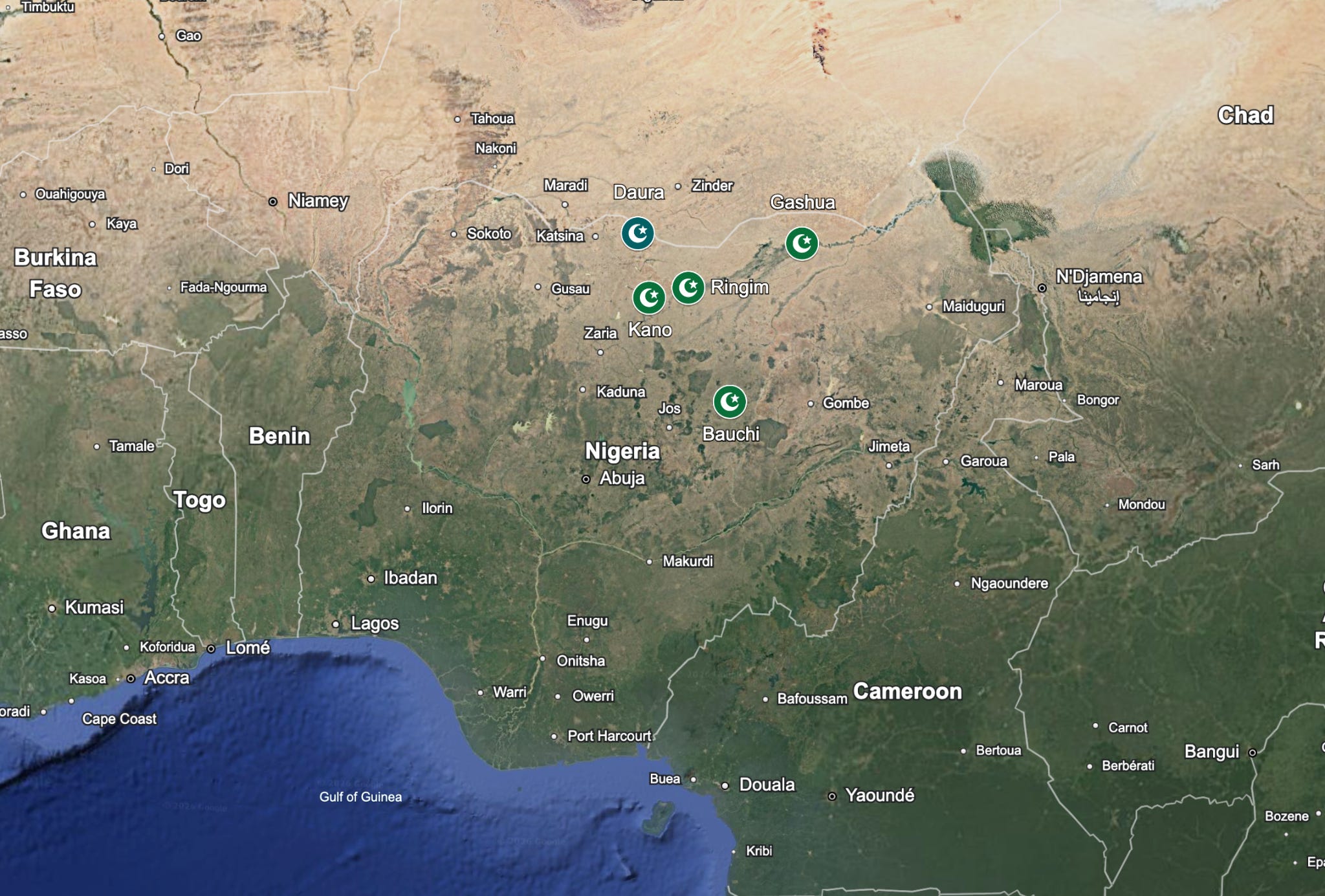
Daura was one of five emirates we visited across Northern Nigeria, along with Bauchi, Kano, Ringim and Gashua. An emirate is a traditional Muslim kingdom, and the emir is its ruler. The north has dozens of them, each with a palace, a court, and a large royal family.
I saw only the surface, of course. This is just one of a handful of brief visits on a 15-day trip all around Nigeria. Yet, everyone in that room accepted the emir’s role seriously and believed in it completely. Watching people sit at a ruler’s feet is outside anything in my ordinary life as an American.
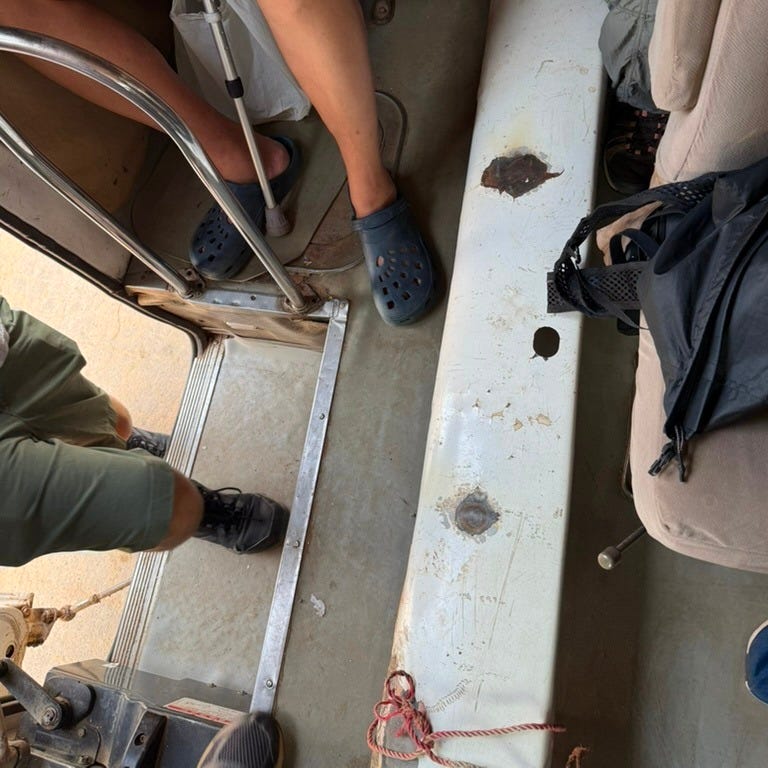
We got around in a bus. A beat-up Chinese one, with broken seats. The bumper fell off on our first day of driving. Since the driver couldn’t put it back on, we spent a week driving with the bumper in the aisle.
Return to sender
Most Americans know one thing about Nigerian princes. They email you. They have millions stuck in an account and need your help (and your bank details) to move it.
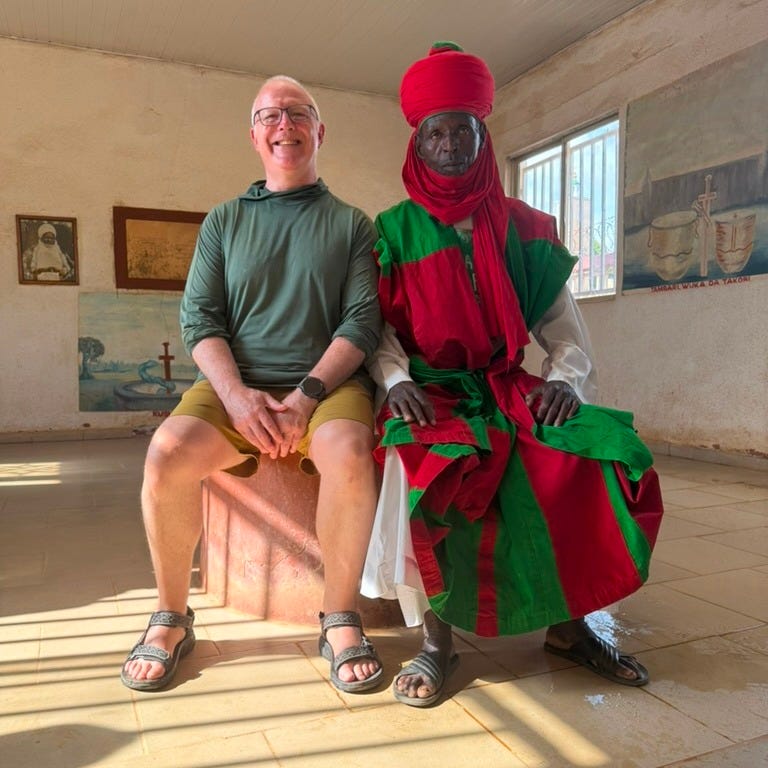
Real princes seem to work differently. You can’t just show up at the palace. Each palace had guards (dogarai) dressed in red and green, and in nearly every town we first met a contact, often a prince, who could admit us. The princes wanted nothing from us. No money changed hands, and no one asked for anything. They have bigger fish to fry than Americans’ retirement savings.
Why does Nigeria have princes? In Daura, it all comes down to the snake.
Well, well, well
We heard the story at the palace when we arrived. In the 10th century, the evil snake Sarki lived in a well and allowed people to draw water only on Fridays, leaving them parched most of the time. One day Bayajidda, son of the king of Baghdad, came to town, slew the snake, and married the reigning queen of Daura as his reward. Their son fathered the first rulers of the seven Hausa states of what became Northern Nigeria. The Hausa remain the largest group in the north, and Hausa remains its common language.
A palace official drew a sword. The blade was long and straight, etched with Arabic I couldn’t read, and hung from a purple cord. We were told this sword killed the snake. A genealogical chart on the palace wall dates the first kings of Kano, Katsina, Zazzau and Gobir to 999 AD, and gives Daura’s first kings reigns of 150, 90 and 115 years. Anti-aging bio-hackers should investigate this.
After that, we visited the Kusugu well, the site where everything happened. The sacred well today sits indoors, in a tiled room, its rim painted red. Visitors offer prayers and make offerings there. While I was there, a palace attendant lowered a bucket, and many splashed water on their faces as a blessing.
The Sokoto Caliphate
The Hausa kings ruled for 800 years, by the palace’s count. In 1804, an Islamic scholar and revolutionary, Usman dan Fodio, declared holy war on the kings, believing them to be corrupt. Dan Fodio was Fulani, from a people spread across West Africa, many of them cattle herders, who lived among the Hausa. His armies mowed through Northern Nigeria, and in 1805 one of his commanders took Daura. Where Hausa kings had ruled, emirs now did, most of them Fulani. Over time the two blended at the top, and Nigerians still call the north’s ruling class Hausa-Fulani.
Dan Fodio’s revolution left behind the Sokoto Caliphate, a loose federation of emirates led by the Sultan of Sokoto.
Daura’s old royalty didn’t disappear. The Hausa set up rival states nearby, and a century later the British made one of their rulers the emir of Daura. Thus, the snake continues to lurk behind the throne.
Horsepower
We visited the palace at Bauchi, too. Bauchi’s founder had been one of dan Fodio’s students, and he was the only definite non-Fulani ruler in the caliphate. At the palace, they showed us the horses and the stables. They dressed up the horses in their parade gear, then dressed a couple of us up like princes and put us on them for photos.
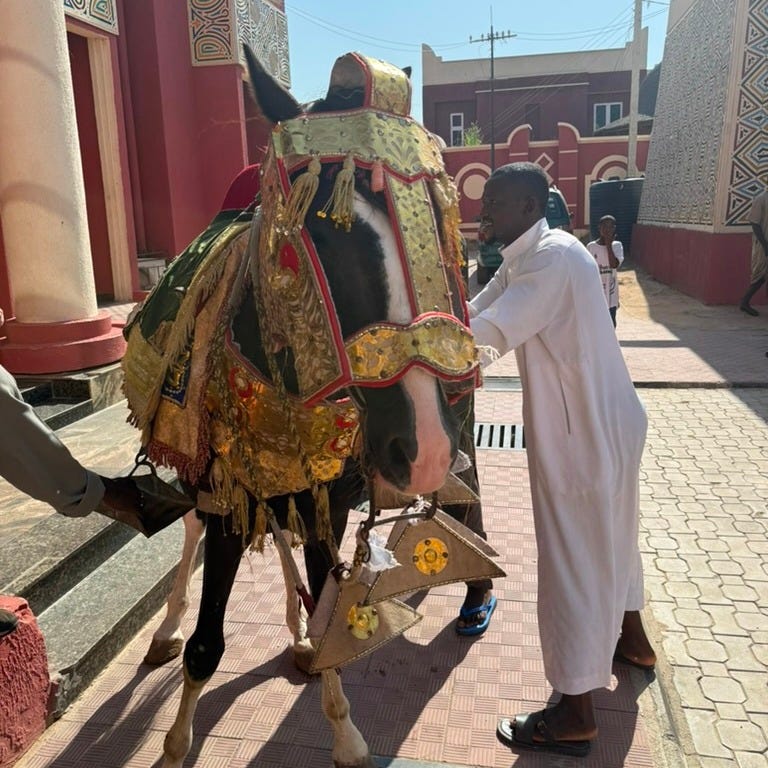
The indirect route
About 100 years after the founding of the Sokoto caliphate, Britain had declared a protectorate over Northern Nigeria, but it existed mostly on paper. Frederick Lugard, the British high commissioner for the north, set out to make it real before a rival European colonial power could. Kano was the north’s great trading city. In February 1903, while its emir was away at Sokoto with most of his cavalry, about 700 African soldiers under British officers blew open one of the city gates with artillery and took Kano. Sokoto fell the next month.
Lugard didn’t replace the emirs. He ruled through them. They kept their courts and collected taxes, but now for the Crown. He abolished the caliphate but kept the sultan’s title. The British governed the south of Nigeria more directly. In 1914, Lugard stitched north and south together into one colony and became the first governor-general of Nigeria.
Ceremonial presidents
A sign in Kano’s palace courtyard lists its 19th-century kings. Sarkin Kano Usman Maje Ringim reigned from 1846 to 1855, and Ringim’s emir comes from the same royal house. But Ringim itself is the youngest emirate of the five. It became an emirate in November 1991, when the new state of Jigawa split off from Kano.
Now, the state governors appoint emirs in this way. The constitution gives emirs no role. State governors appoint them and can remove them. After a 1976 reform of local government, the emirs complained it had caused them “to cease to be anything but ceremonial Presidents.” They still have influence, though. They settle disputes and stand between their people and the state.
Aside: Nobody mentioned it while we were there, but Kano currently has two emirs. In May 2024, the state governor reinstated Muhammadu Sanusi II, who had been deposed four years earlier, and removed the sitting emir, Aminu Ado Bayero. Each now holds court in his own palace while the case awaits the Supreme Court.
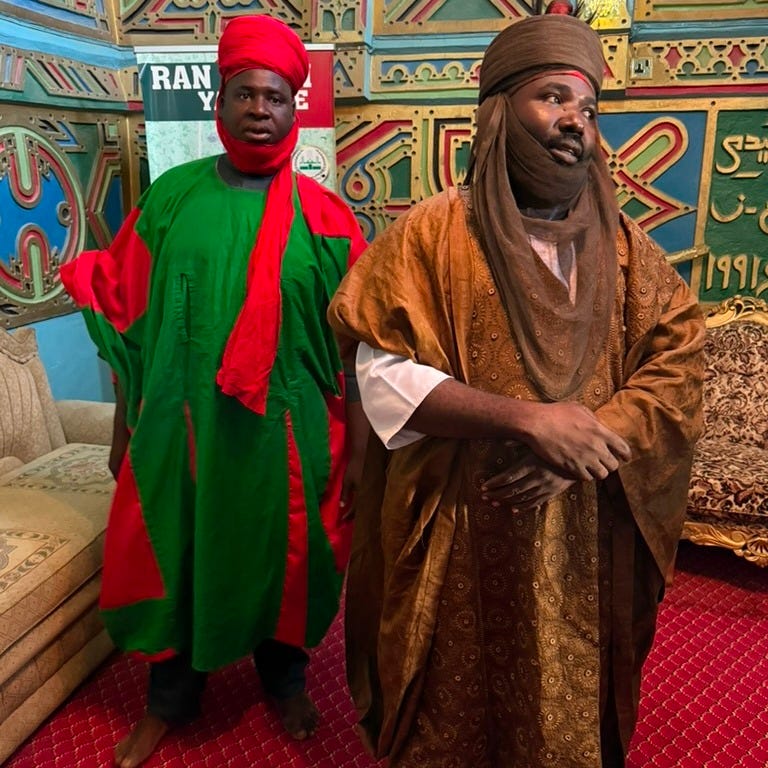
The prince who received us in Ringim wasn’t a crown prince. He said he ranked far down the line of succession as a younger child when I asked about the royal family. A white 1970s Cadillac sat in a garage at the palace, its plate reading “His Royal Highness, Emir of Ringim, Jigawa State.” The floor of the garage was sand. The ceiling tiles showed wear and tear. Kano’s fleet was grander: a light-blue Mercedes 300 convertible, a black Cadillac stretch limousine, and a blue car I think was a Daimler, its plate reading KANO EMIRATE. The palaces are luxurious in the midst of the surrounding towns. By the standard of Versailles or the Habsburg palaces of Vienna, less so.
Hats off
In Gashua, the only entrance to the palace was through a prince, so we visited his home first. Alhaji Mamman Sale Suleiman, Majidadin Bade, received us in a room with a chandelier, a flat-screen TV, a pedestal fan, and a framed peacock portrait leaning against the wall. Behind his chair, gilded and draped in white sheepskin, the Throne Verse from the Qur’an ran in green letters down a gold wall.
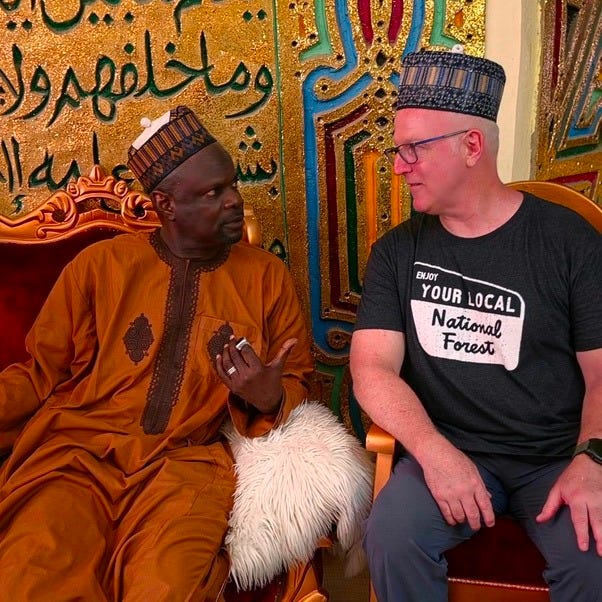
A sword and a leather bag hung nearby. Over a doorway was a portrait of Alhaji Saleh Suleiman II, Emir of Bade from 1981 until his death in 2005. The prince sat on the sofa with us. Two men sat on the floor, one of them our guide, Amir, just listening.
The prince apologized. He only recently learned about our visit, so he couldn’t offer us a meal or anything more complex. He moved into the other room and returned carrying hats from his collection. We were in his home.
We wore the hats for the rest of the visit. Mine is in my room at my home.