


The wall was not for climbing. Four feet of coarse cement and rock, more barrier than boundary. I scaled it anyway, hands scraping on the craggy surface, hauling myself over as if I were bouldering. When I touched down on the other side, the January sun was directly overhead, severe and shadowless.
The sandy humps extended in waves, reaching houses far away. They looked like an abandoned construction site, as if someone had driven a small bulldozer here and heaped dirt into thousands of mounds for some future purpose that never materialized. Traffic sounds from the nearby road passed through the dry air. People going about their daily lives.
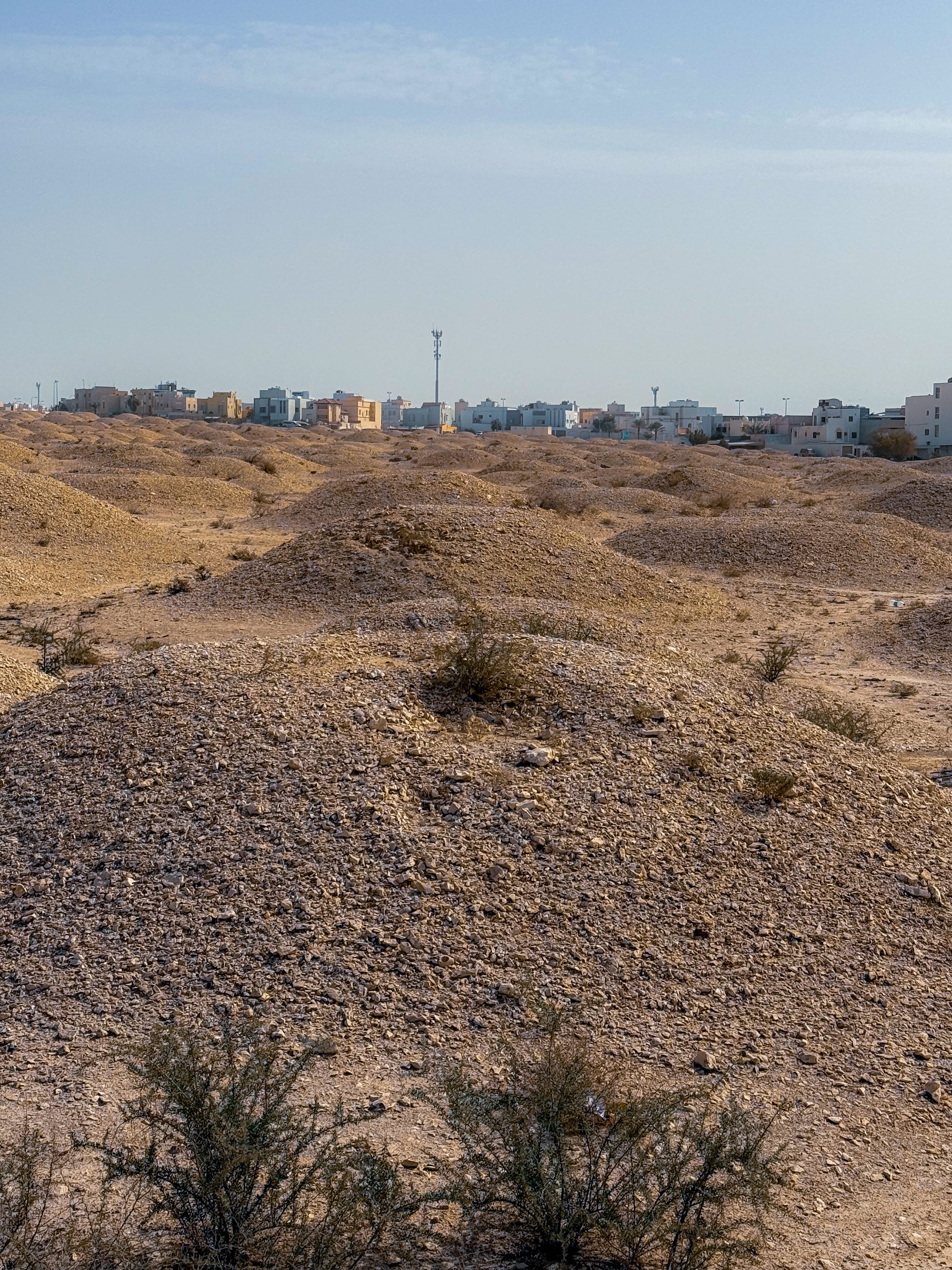
Suburbia among the sepulchers
A field of graves. Not hundreds. Thousands. Maybe tens of thousands just in this residential neighborhood in Madinat Hamad in Bahrain. Over my hotel breakfast, I’d read that most archaeologists estimate somewhere between 80,000 and 172,000 burial mounds scatter across the island’s thirty-mile length. No one seems to have an exact number because some “mounds” are iffy after a couple thousand years. Plus, development has crushed thousands. Even the low estimate makes this one of the largest prehistoric cemeteries in the world. I had expected official infrastructure—parking, pathways, explanatory materials, the things you see at a state park exhibit. Instead: a low rock wall surrounded by houses on three sides. No signs. I’d parked behind someone’s house on the dirt because there was no designated parking area.
What shocked me wasn’t only the scale. It was how completely everyday life had absorbed the mounds. Bahrain’s authorities protected and highlighted them in some parts but mostly left them to their own devices in places like this.
The mounds stood about four to five feet tall. Sandy beige earth peppered with large white rocks. Some of those rocks had an unusual shape, a rougher texture, and were too long. I picked one up. Could bone petrify like this after thousands of years? I’m not an archaeologist. I couldn’t tell. But once I saw what I thought was a bone, I couldn’t unsee it. (I’ve since learned they are limestone fragments from the internal burial chambers. Still can’t unsee it. )
Far across the field, maybe two football fields away, a man walked his dog. A small dog, breed indistinguishable at that distance. He moved at a casual pace between the mounds, following what was clearly a regular route. He seemed entirely matter-of-fact about his walk, the way you’d walk a dog in any neighborhood park.
Plastic bags hung in the thorny bushes. Small blue convenience store bags, the kind that litter the world. They caught near the bottom of the spiky plants, along with paper trash and plastic bottles. Some looked as if they had blown in during heavy weather. Some felt like the remnants of teenage boys hanging out, the way teenage boys hang out in empty lots everywhere.
I climbed one mound to get a high point for a photograph. The surface was slippery—rocky and sandy, like trying to climb the side of a steep dune. When I reached the top, guilt settled over me. There’s a person under here. How deep is the body? Are some of these white rocks actually bones? Will someone come tell me to get down? No one came. It was hard to feel triumphant standing on someone’s grave. I took the photo and climbed down.
Later, at the Bahrain National Museum, I dove deeper into who these people were. The dead beneath my feet belonged to Dilmun, a civilization that flourished here for three thousand years, from around 3200 BC until foreign conquest ended it in the sixth century BC. The museum’s exhibits explained the mythology: in Sumerian texts, Dilmun was the Land of the Living, the place where the sun rises, the terrestrial paradise where disease and aging did not exist. Ancient tablets describe it as pure and virginal, a place where “the wolf snatches not the lamb.” When Utnapishtim—the Sumerian Noah—survived the great flood, the gods granted him eternal life and sent him to live in Dilmun. The museum placard proposed that the Sumerian accounts of Dilmun’s paradise could be the inspiration for the biblical Garden of Eden.
The inhabitants of Dilmun apparently saw their island as the entrance to eternity. Behind glass, the museum displayed what they buried with their dead: ceramic urns, shell and bead jewelry, copper and bronze tools, and the remains of fish and sheep. Provisions for the journey. The massive Royal Mounds at A’ali, some reaching 40-50 feet high, held stone vessels inscribed with the names of kings in Akkadian cuneiform. When archaeologists excavated these mounds in 2017, they identified Kings Yagli-El and Rimum, rulers from around 1780 BC. These names had only appeared in foreign texts up to this point. The glass cases held circular stamp seals found throughout the mounds—distinctive to Dilmun, different from the cylindrical seals of Mesopotamia.
Exhibits explained why Dilmun could support such an elaborate civilization. Surrounded by the barren Arabian Peninsula, Bahrain had springs where fresh water bubbled up from beneath the saltwater seabed. Accounts from 1489 describe divers submerging into the sea with a skin, filling it with fresh water from underwater springs. The island’s name—Bahrain—means “two seas,” the mingling of salt and fresh. This abundance allowed for lush vegetation, agriculture, dates, and grains. It made the island sacred in Mesopotamian mythology, the site where Creation occurred.
The well runs dry
These springs are no more. The shrine of Nabi Saleh, where families once gathered at a freshwater spring, is now a dry hole surrounded by car parks where orchards used to grow. Artesian wells have dried up because of climatic changes and over-extraction. The principal aquifer suffers from severe salinization. What made Bahrain sacred—the thing that separated it from its neighbors, that allowed a great civilization to flourish here—has vanished.
But other things flow through Bahrain now. Between 2000 and 1600 BC, Dilmun functioned as the commercial middleman between Mesopotamia and the Indus Valley, controlling the Persian Gulf trade routes. Circular stamp seals had shown up in India, Kuwait, and throughout Mesopotamia. Physical proof of a long-distance network that moved copper from Oman, timber and ivory from the Indus, lapis lazuli from Afghanistan. Dilmun merchants exported pearls (“fish eyes”) highly prized in Mesopotamia.
The new middlemen
The island has always been a crossroads. What crosses it has changed. At breakfast the next morning, the servers at my hotel—the Intercontinental in central Manama—were Bangladeshi. Jewel had been in Bahrain for five years. He goes home every other year for at least a month for family gatherings like weddings. The higher wages he earns here more than make up for any homesickness, he said. His colleague Monir showed me on my phone where he lived near Chittagong. They were both enthusiastic and perky despite running around frantically. When I mentioned I’d been to many places in Bangladesh, they lit up with pride.
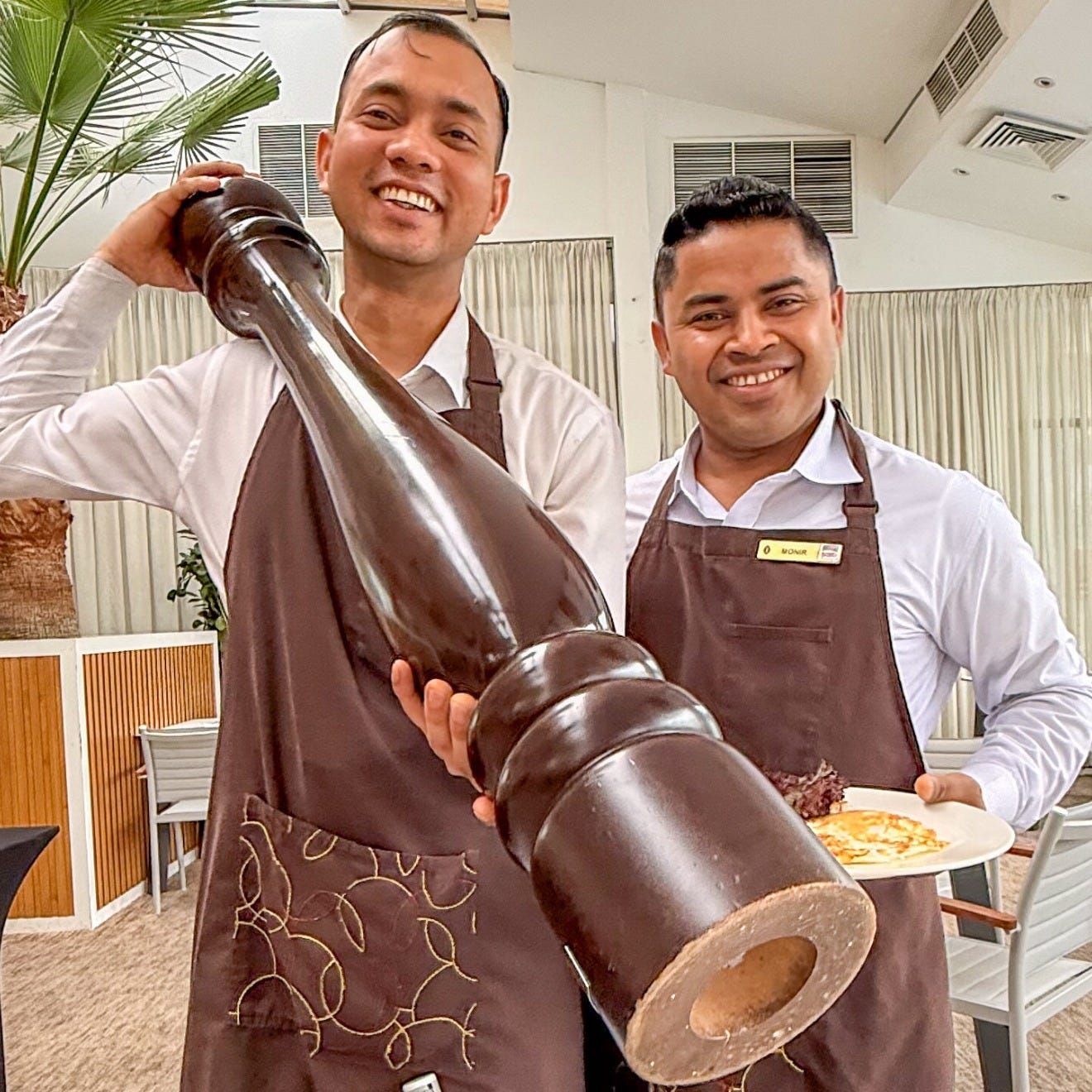
Jewel is one of over half a million foreign workers in Bahrain—more than half the population now, a threshold crossed in 2010. They also make up 70-78% of the workforce. Indians are the largest group, over half from Kerala. The rest from Pakistan, Bangladesh, and the Philippines. They make up seventy percent of the workforce, concentrated in manual labor and construction. This tradition started with oil in 1932—Bahrain didn’t have enough people to fill positions in the oil industry, so they imported workers and built the company town of Awali near the oil fields to house them. Instead of copper and pearls flowing through the island, now it’s labor.
Throughout Manama, Filipinos worked as hosts and in in front-desk roles. Rwandans worked at my hotel’s front desk. Men from South Asia in shops, wearing casual western dress when not in uniform. Bahraini women wore hijab. Men wore western clothes or Gulf dress. The visual contrast was constant.
Manama itself felt less brash than Doha or Dubai. It developed earlier, and the buildings show a greater range of age. Modern showy skyscrapers sit near simple four- or five-story glass and concrete boxes with utilitarian purposes. The high-rises are on the periphery of the old city. The pace of life during the day is quiet. Weekends are different.
Weekend at Dilmun’s
Thursday night marks the start of the weekend in the Gulf. Trying to get back to my hotel, I inched forward in traffic then sat still for ten minutes, inched forward, sat still. King Fahd Highway packed solid. Modern Toyotas, Nissans, Mitsubishis. Some American makes. Horns—not the constant blaring of Dhaka or Mumbai, but enough to puncture the night. On a street corner in the old town, young girls in hijabs stood ready to cross, shooting phone photos of each other against the building facades—blues and purples and reds washing over them from the LED lights. The traffic crept forward.
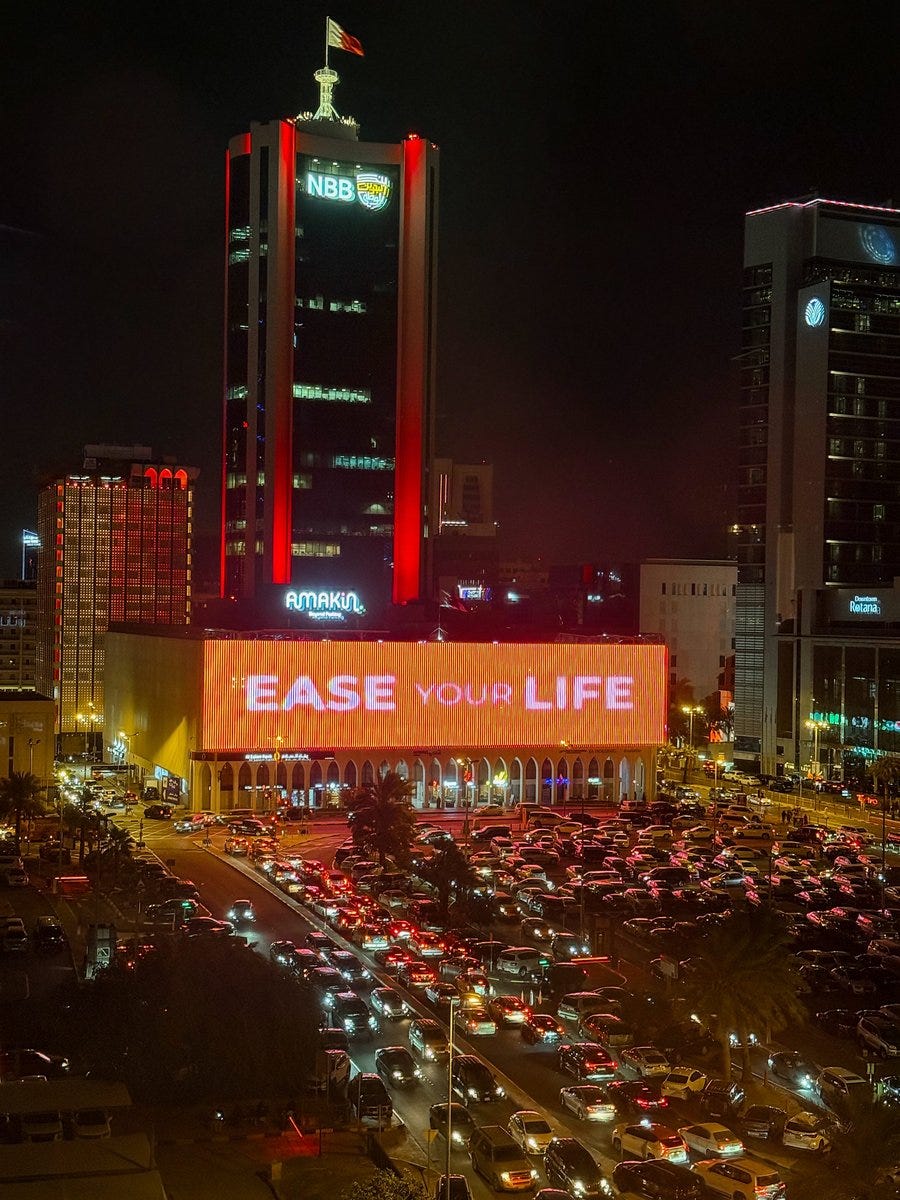
Bahrain is where Saudis come for the weekend—a forty-five minute drive over the water for movies, concerts, dining, nightlife. Although Saudi Arabia is changing rapidly, Bahrain is still more relaxed about alcohol, dress codes, and mixing between men and women. For years, Saudis could only see movies in Bahrain. Old habits die hard. They still come.
The second burial site I visited had more infrastructure. Saar Archaeological Site—2050 to 1750 BC, excavated in the 1990s by a British-Bahraini team—had explanatory signs. One warned that any extraction of sand, excavation, or garbage disposal is prohibited and punishable under the Law Concerning the Protection of Antiquities, 1995. I was hoping for a different explanatory sign. I frowned we needed this in the first place at one of the country’s most important archeological sites.
Saar was more of a full city with burial mounds included. The settlement: eighty-four well-preserved houses built in blocks, organized by two main streets and several alleys. A temple, a circular water well, and a kiln. The burial grounds featured an uncommon design—interlocked graves with central chambers surrounded by semi-circular walls, connected like beehive cells. The honeycomb cemetery.
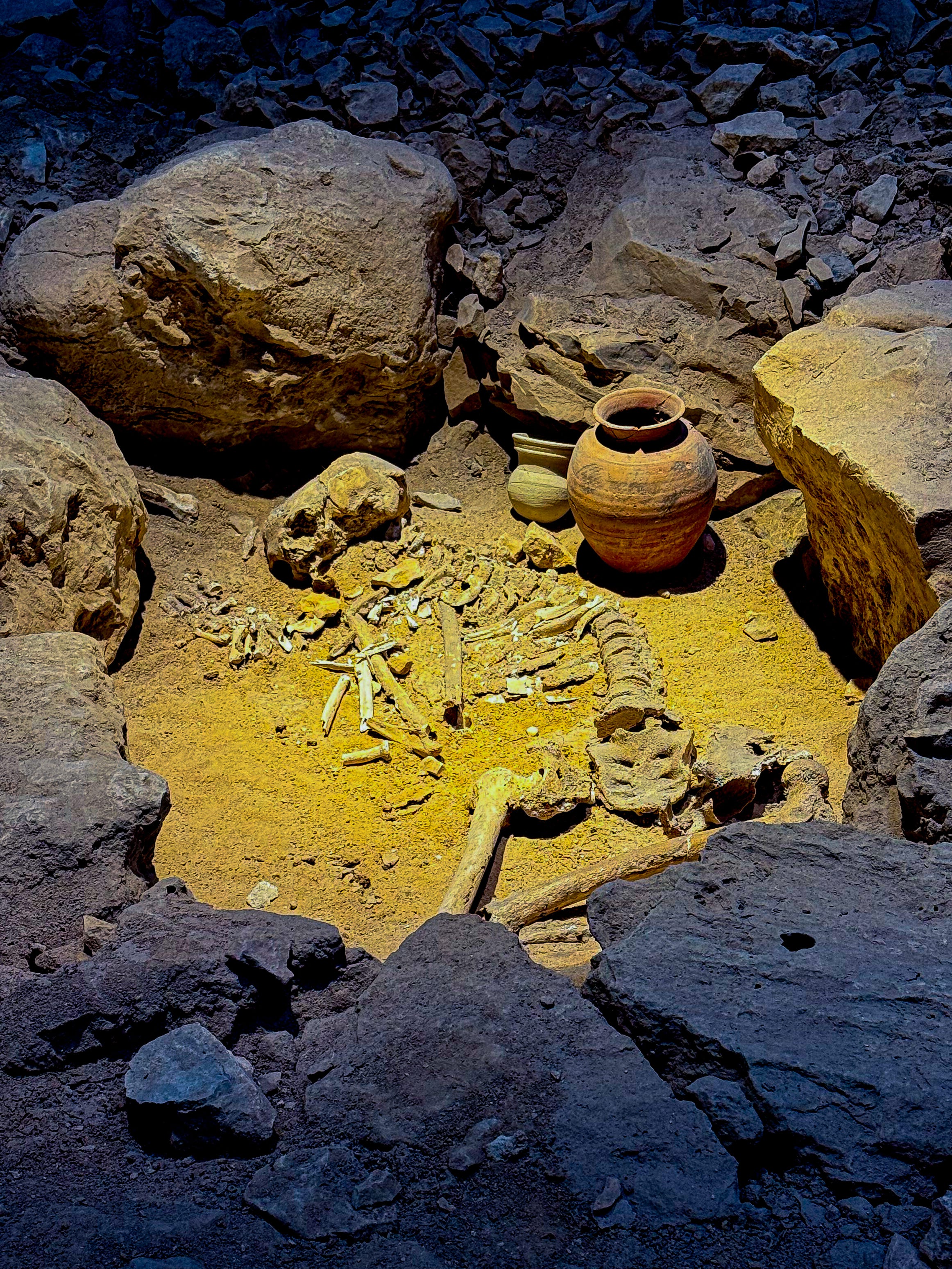
I had the place to myself. No watchman until I was leaving. Two hours walking the entire grounds. There were signs of life. A butterfly appeared in the middle of all this desert, then a beetle. The honeycomb graves became redundant—the pattern repeated, impressive but repetitive.
What struck me most was the ordinariness. Not the scale, not the lack of protection, but the way these mounds just exist in the landscape like any other feature. In the nineteenth century, some scholars believed the island was solely a giant necropolis for mainland Mesopotamia because the density of graves seemed impossible for a local population. Modern archaeology confirmed these are Dilmun’s own dead, their prosperity funding such elaborate customs.
The government has made some efforts at protection. In 2019, the Dilmun Burial Mounds became a UNESCO World Heritage Site. The government oversees excavations, managing the tradeoffs between urban development and heritage conservation on an island of roughly 760 square kilometers with one of the world’s highest population densities. International teams from Denmark, France, and Bahrain continue researching. The 2017 discoveries at the Royal Mounds made headlines. The National Museum displays pottery, jewelry, and seals from excavations.
Paradise, paved
But modern development has flattened many mounds. No one tracks an exact count, but the losses are substantial. Both the ancient burial mounds and the modern population concentrate in the northern part of the main island. As towns like A’ali and Hamad Town expanded to house growing populations, they inevitably encroached on the vast fields of graves. Selective protection saved the high-value clusters--the Royal Mounds, sites like Saar. The rest sit in residential neighborhoods, unremarkable, absorbed into daily life.
At the first site in Madinat Hamad, I’d felt sad realizing there were no rules, no infrastructure. Such an important place, once home to a great civilization, and now many people could walk by without knowing what it is. By the time I left Saar, that feeling had shifted a little. Not quite acceptance, but recognition. On a densely populated island where housing demand is constant, preserving every one of tens of thousands of mounds is impossible. The question becomes which ones to protect and how.
Dilmun built this elaborate landscape of death because they believed their island was the gateway to eternity, the Land of the Living where immortals dwelled. They set up their dead for a journey to a paradise that, in their cosmology, existed right here—in Bahrain itself, where fresh and salt waters met, where disease did not exist, where the sun rose each morning over sacred ground.
I can’t prove the loss of those springs is why the mounds feel ordinary now--why a man walks his dog through graves the way you’d walk through any park, why plastic bags catch in the thornbushes. The myth depended on water. Modern Bahrain no longer has those springs, but has oil instead.
The sacred has become ordinary in places. Bahrain remains a crossroads, but for different travelers now—Bangladeshi workers sending money home, Saudi families cruising the causeway for weekend movies, foreign laborers building the infrastructure of modern life. The ancient dead rest beneath it all, mostly forgotten, occasionally studied, their elaborate arrangements for eternity lying in darkness under neighborhoods where children play and satellite dishes pepper the rooftops. The Land of the Living, where everyone now just lives.