


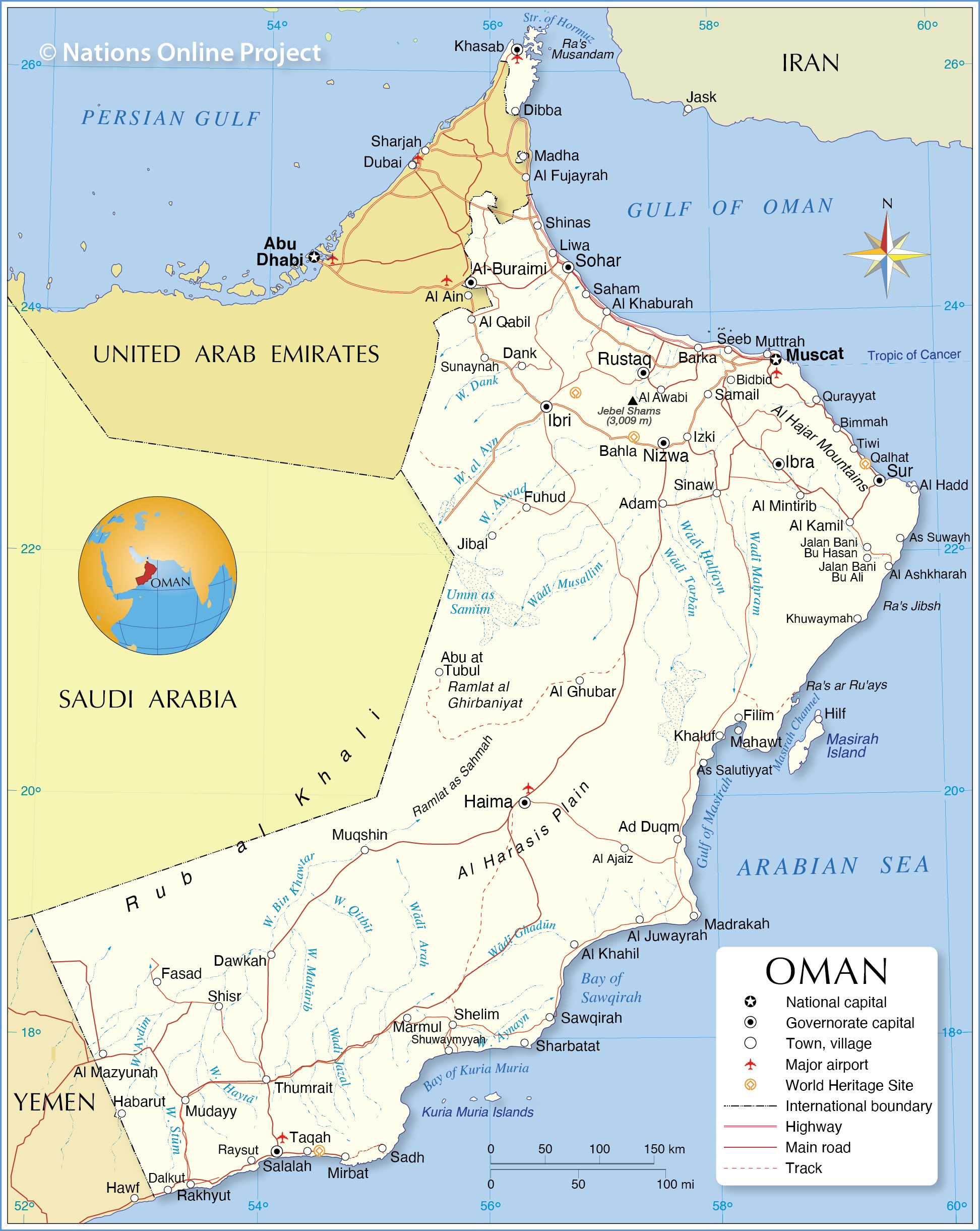
Country Statistics
Population (2024) - 5.3 million; 56.4% citizens
Population Growth Rate (2024) - 4.5%
Size - 309,500 k2 (119,499 sq mi) - a little bit smaller than the state of New Mexico or a bit bigger than Italy
GDP (nominal 2024) - $107.14 billion
GDP per capita (nominal 2024) - $20,285.20
GDP per capita PPP - $41,740
Inflation rate (2024) - 0.6%
Biggest export - petroleum products. 64% of all export revenue, 45% of government income, 50% of GDP
Median age (2025) - 27.5 years
Life expectancy (female/male) - 82/78
Murder rate (2023) - 0/100K
Ethnicity - Arab, Baluchi, South Asian (Indian, Pakistani, Sri Lankan, Bangladeshi), African
Religion - Muslim 85.9%, Christian 6.4%, Hindu 5.7%, other and unaffiliated 2% (2020 est.). Omani citizens are 95% Muslim - 45% Ibadhi, 45% Sunni, 5% Shia, 5% Christian, Hindu, or Buddhist.
Corruption Perceptions Index - Rank #50/180
Index of Economic Freedom - Rank #58/184
Omani citizens represent approximately 56.4% of the population and are overwhelming Muslim (Ibadhi and Sunni sects each constitute about 45% and Shia about 5%); Christians, Hindus, and Buddhists account for roughly 5% of Omani citizens
The map and statistics format comes from Matt Lakeman.
Getting My Goat
I saw just a couple of goats at first. I was too focused on keeping my rental Chinese sedan from spinning out on the canyon floor, the rocky, dusty path threading between walls of rust-colored rock that shot straight up on either side. Then one lifted its head from a shrub—long-haired, unhurried—and I realized dozens of them were scattered along the route, lying in the winter sun as if they owned the place. They moved aside only when my front bumper got close enough to inconvenience them.
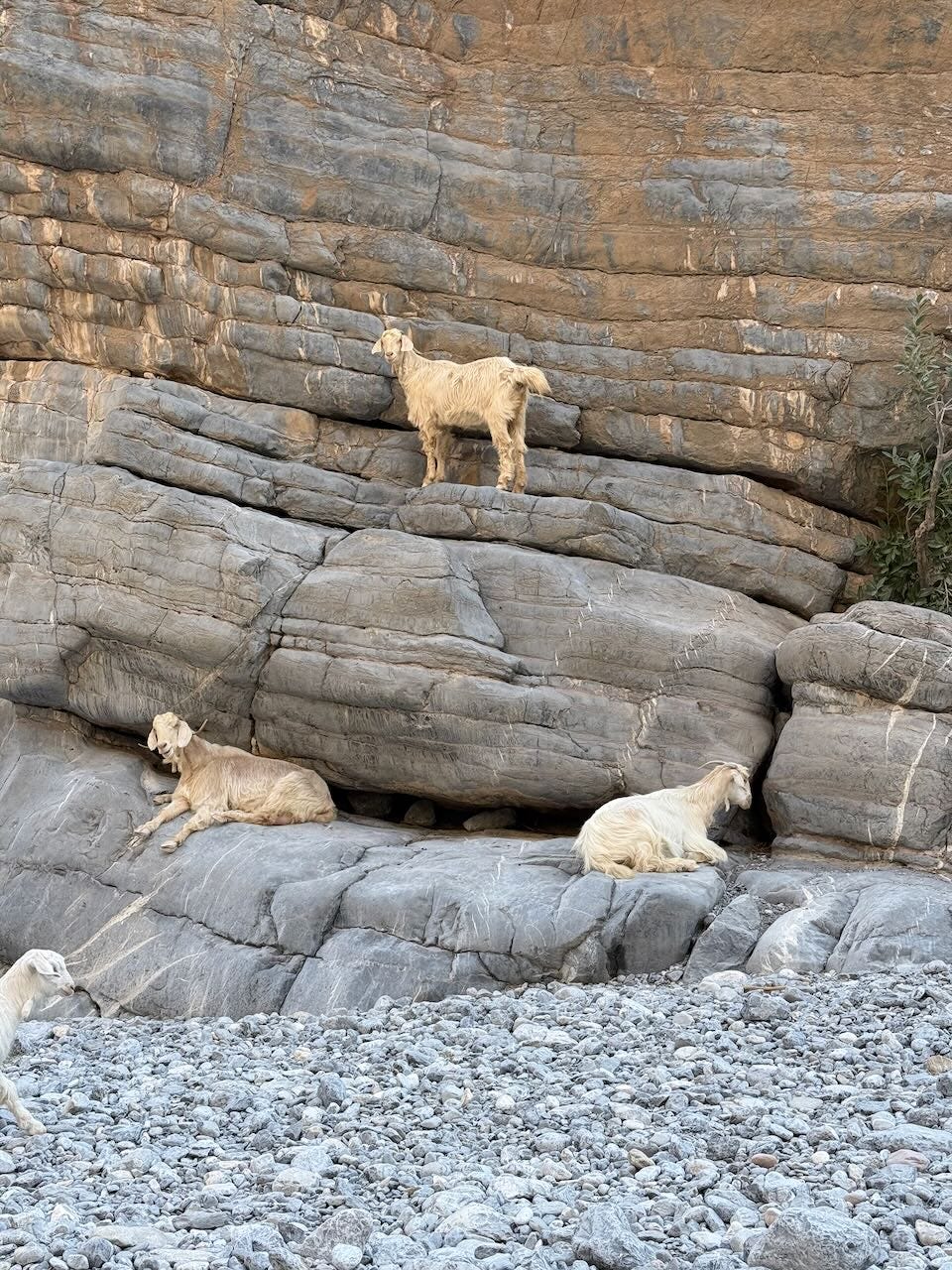
I’d stumbled into this canyon behind Wadi Tanuf by accident, curious why other cars kept driving up the dirt road past the wadi, then turning around. No signs. No markers. Just worn tire tracks disappearing into the rock. The wadi itself had been dry when I arrived, so I followed the path in, wheels kicking up soft sand and loose stones. When they spun out the second time, I thought: this is how you get yourself into a fix. No other cars. 3G cell service, maybe. Just me, a two-wheel-drive sedan, and goats that clearly belonged to someone I never saw.
Low Key, With Cap
I’d come to Oman for a week after visiting family in Addis Ababa, covering the stretch from Muscat to Nizwa and the surrounding areas. I’d expected—though I tried not to have expectations—something harder to navigate, more opaque. Instead, I found a place that felt remarkably open, low-key in a way that the rest of the Gulf mostly isn’t.
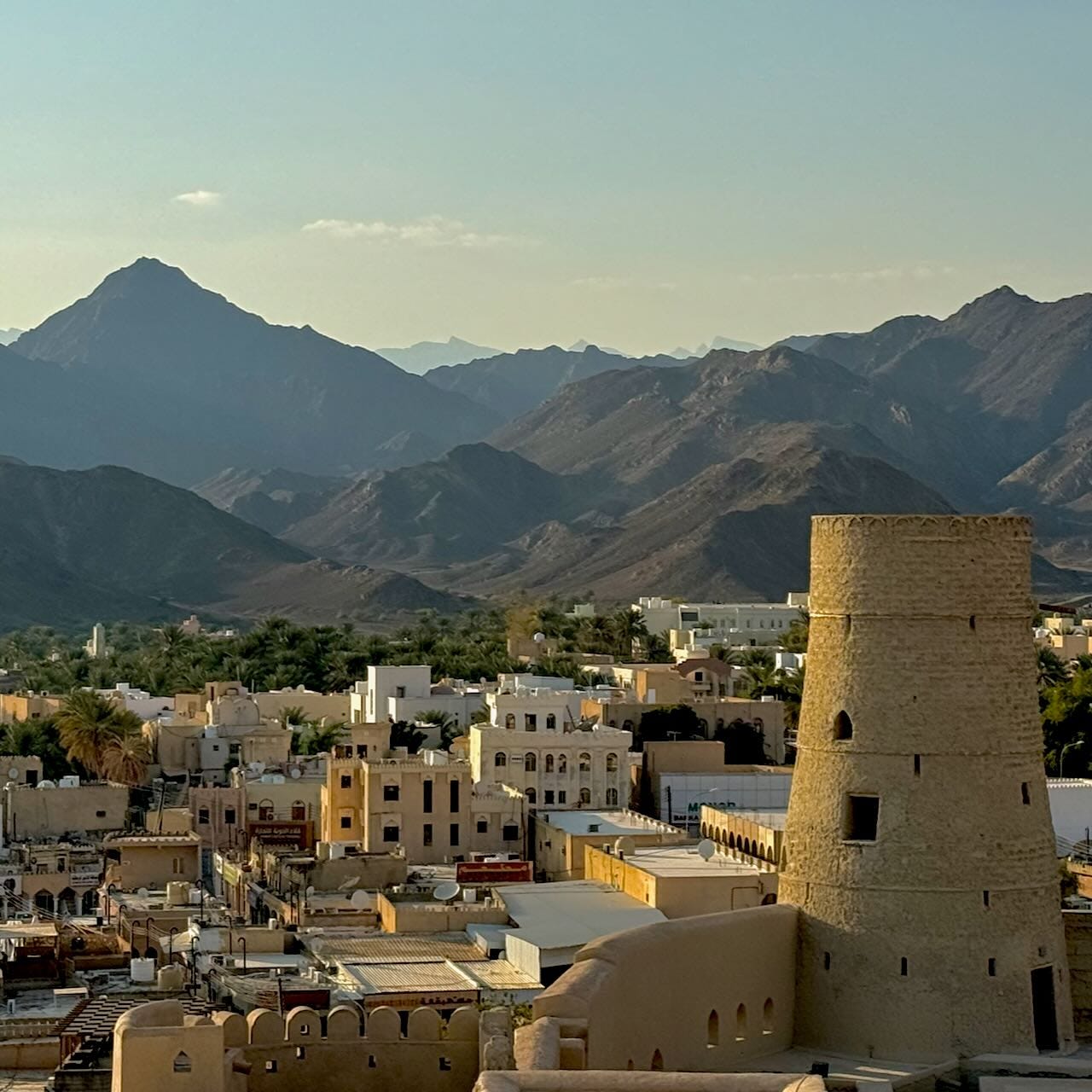
The architecture tells you this immediately. Driving from the airport through Muscat, you don’t see forests of skyscrapers competing for height. Buildings stay low to the ground, Arab in style, white or beige against the mountains. The emphasis seems to be on development that serves people rather than statements—roads that work, neighborhoods that breathe, a city that hasn’t erased what came before it.
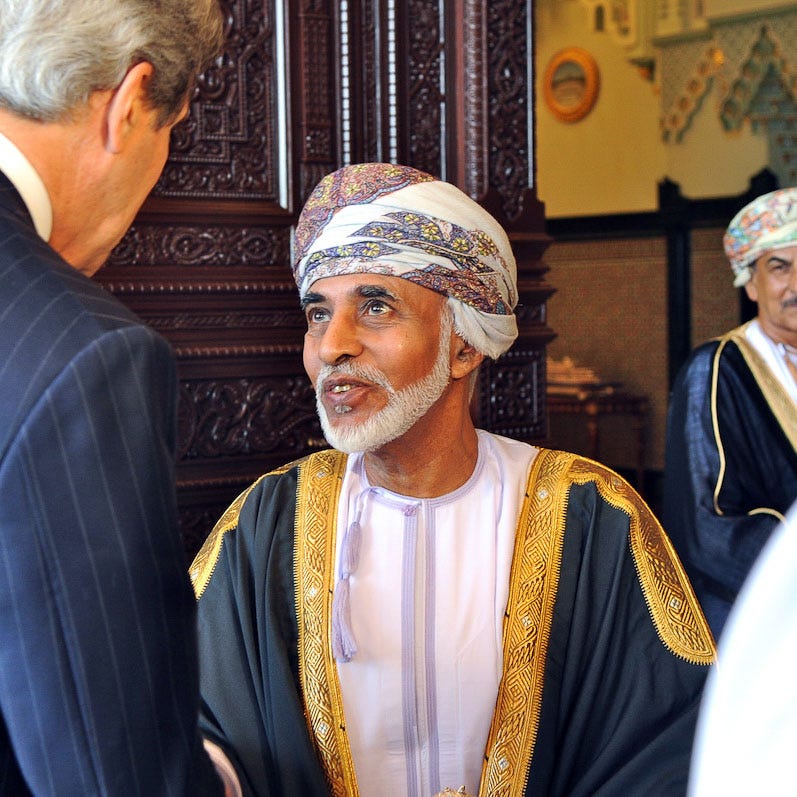
And the men wear dishdashas. Not some of them. Not on special occasions. Nearly every Omani man I saw wore the traditional white, collarless gown with an embroidered kummah cap. This wasn’t heritage dress hauled out for tourists—it was Tuesday afternoon at a gas station, Thursday morning at the souq. Traditional culture as a daily fact, not a museum exhibit.

Dawn of a New Era
The easiest way to understand modern Oman is to know that fifty-five years ago, there were ten kilometers of paved roads in the entire country. Ten. The Sultan banned radios, eyeglasses, and umbrellas. He viewed schools as incubators for dangerous ideas—there were three primary schools serving nine hundred boys, zero girls. Life expectancy hovered around forty-nine. Slavery was legal. If you’d visited in 1969, you would have arrived in a medieval state called “Muscat and Oman,” a bifurcated territory where people needed permission to travel between towns.
On July 23, 1970, a twenty-nine-year-old named Qaboos bin Said overthrew his father in a British-supported palace coup and declared: “Yesterday, Oman was in darkness... But tomorrow, a new dawn will rise for Oman and its people.” They call it the Nahda—the Renaissance. Everything you see now was built since then. The roads. The hospitals. The schools. Women in government positions. The opera house. The fact that life expectancy is now seventy-six instead of forty-nine.
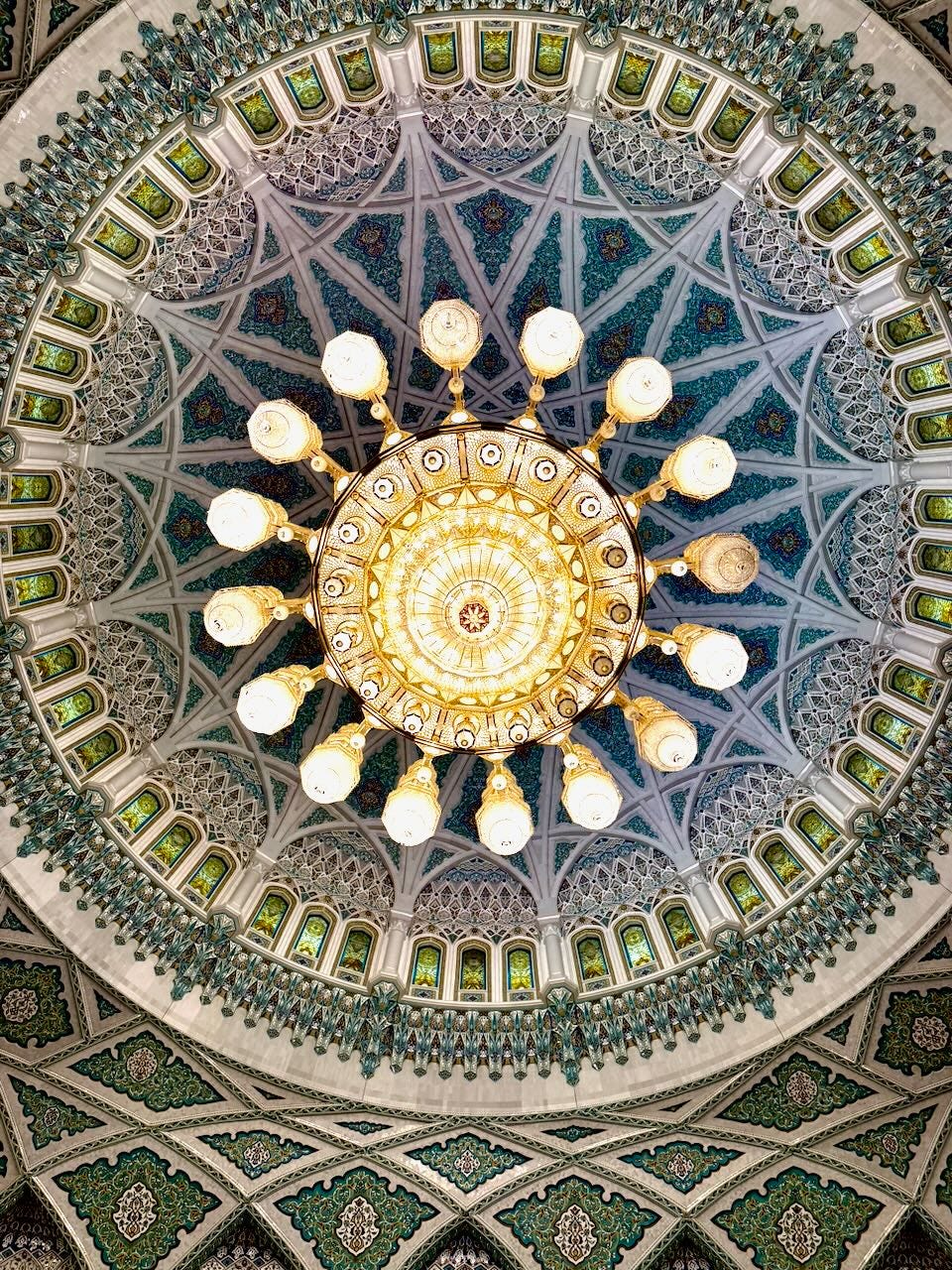
I thought about this while standing inside the Sultan Qaboos Grand Mosque, which opens to non-Muslims each morning before the Dhuhr prayer. I’ve seen ornate mosques—the tile work in Qatar, the mosaics in Istanbul—but what distinguished this one was how the elements worked together: the enormous blue rug stretching across the prayer hall, the contemporary Islamic styling of the arches, the way the color scheme of the interior dome played against rich wood panels. Around the exterior, niches paid homage to other Islamic art traditions—Persian, Turkish, Moroccan—without mimicking them. It felt less like a monument to wealth than a carefully considered space that honored both tradition and the present moment.
Feast in the East (Middle, that is)
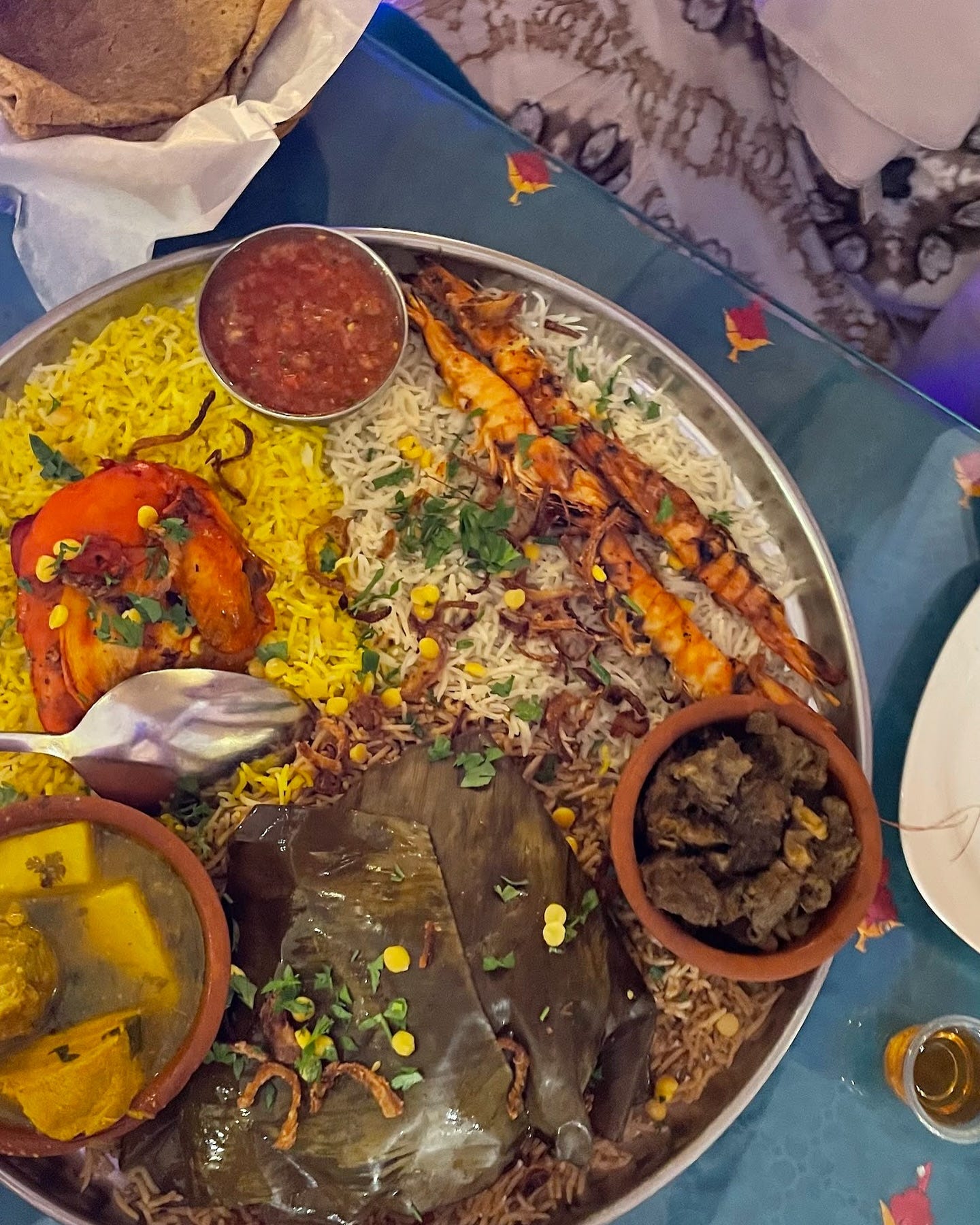
That night I ate at Ramssa, a traditional Omani restaurant where I sat on carpeted floor cushions in a booth while staff laid down plastic sheeting to protect the rugs. The starters came first: hummus, baba ghanouj, muhammara thick with roasted red peppers and walnuts, arugula salad scattered with pomegranate seeds. Then the mains: camel miqlay cooked with spices and served with honey and local bread; chicken mandi over biryani rice; lamb shiwa—marinated meat slow-roasted for days, traditionally in underground ovens—with qaboli rice studded with raisins and chickpeas; fish bablo, a stew flavored with dried lime and turmeric; shrimp mishkak grilled on skewers and served in tangy tamarind sauce. For dessert, luqaimat—crunchy fried dough balls crisp on the outside, soft within, drizzled with date molasses—and milk pudding topped with sweetened vermicelli. The meal ended with Omani coffee, kahwa, cardamom and saffron-scented, served in small cups.
Welcome to Our Home
Getting around had been simpler than I’d expected. I rented a car cheaply at the airport, used Google Maps to navigate, and found that Omanis drive much like Westerners—lane discipline, reasonable speeds, none of the chaos I’d braced for. Food was easy to find: Arab, Indian, and Western options scattered throughout. The weather held at pleasant and sunny, cool enough at night that could put on a light jacket if you wanted to.
What struck me most was how comfortable I felt as a visitor. Every Omani I met welcomed me to their country with genuine pride—the people eating next to me at restaurants, the police at the airport, and people I met just walking around. Most conversations were same-sex given cultural norms, and since I was traveling alone, my interactions stayed surface-level, but the hospitality was real, not performed.
Oman’s distinctiveness comes from what it isn’t as much as what it is. It’s the only Gulf state—the only country, period—dominated by the Ibadi sect of Islam, neither Sunni nor Shia. This gives it a sectarian neutrality that functions like diplomatic armor. While Saudi Arabia and the UAE have engaged in military interventions across the region, Oman has maintained a policy of “friend to all, enemy to none.” It didn’t join the Saudi-led coalition in Yemen. It didn’t take part in the 2017 blockade of Qatar. Instead, it serves as the back channel, the interlocutor—it facilitated the secret talks between the United States and Iran that led to the 2015 nuclear deal.
Unlike its wealthier neighbors, Oman has smaller oil reserves and higher extraction costs. Experts estimate the reserves could be depleted within twenty years, forcing a post-oil reckoning sooner than Qatar or the UAE will face. The government has responded with aggressive “Omanization,” replacing expatriate workers with locals in over two hundred job categories, and Vision 2040, a diversification plan focused on tourism, logistics, and manufacturing.
But Oman also has something its Gulf neighbors lack: the memory of empire. In the eighteenth and nineteenth centuries, the Omani Empire stretched from the Strait of Hormuz down the East African coast to Zanzibar. This gives the country an Indian Ocean identity, a historical self-confidence rooted in something older than oil money and glass towers.
I didn’t go as far as I wanted—my rental wasn’t built for it, and after the wheels spun out twice in soft sand, I decided not to test my luck. But I drove far enough to feel the canyon walls closing in on either side, far enough to be alone with the goats and the silence and the realization that in Oman, you don’t need to be particularly adventurous to find yourself somewhere that feels out of the way.
A week wasn’t enough. I needed ten days or more. I would have gone south to the desert, hiked deep into the wadis, spent more time in the mountains. The pace in Oman is slow, without spectacle or rush. The country doesn’t demand you be impressed. It simply exists, confident in what it is, built carefully over fifty-five years from almost nothing into a country that feels both modern and rooted, comfortable and distinct.
As I drove back to Muscat on modern highways that didn’t exist until 1975, I thought about those ten kilometers of paved road in 1970. The goats in the canyon. The dishdashas and kummah caps. The Grand Mosque’s blue rug. The way the Omanis I met said “welcome to our country” like they meant it, excited to introduce you to what they had.
Enjoyed reading this Jeremy. I must get back to Oman!
Fantastic article. So well written and insightful.